HELPING CUSTOMERS FIND ANSWERS
Instead of asking customers to choose where to get help, we designed a single experience that met them where their intent began.
Timeline
Initially 6 months before we went live and then another 1.5 years (it became more maintenance heavy after 15-18 months).
Team
Product Manager
Conversation Designer (me)
AI/ML engineers (external vendors from New York)
UX Designer (temporary; for the first 5-6 months)
Research
Accessibility
Localization
Business stakeholders (across 10-12 LOBs)
Background
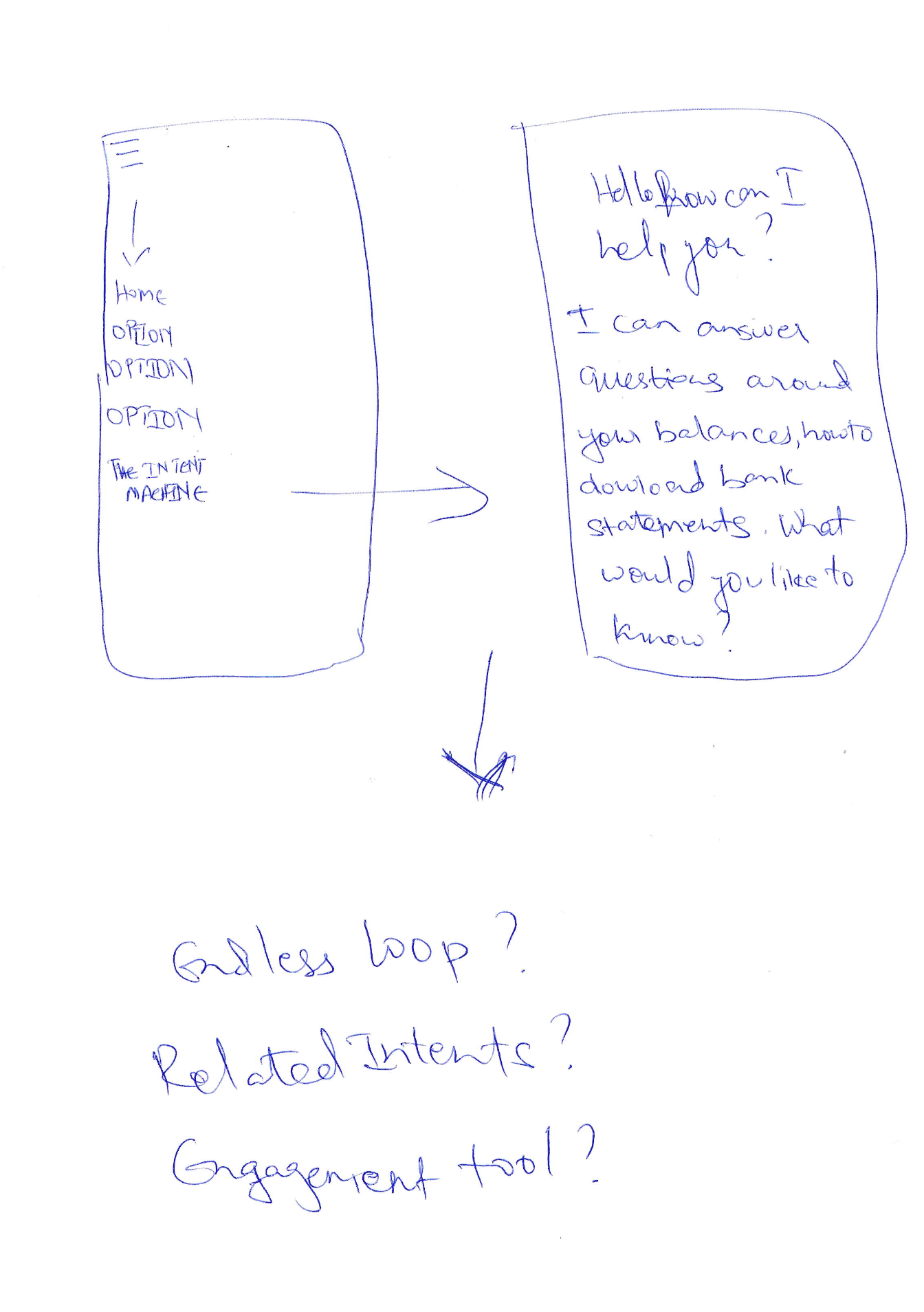
Existing support experiences were fragmented. Customers had to decide whether to browse FAQs, call support, or visit a branch. We saw an opportunity to unify high-frequency questions and account-related tasks into a single conversational experience on the TD app.
Discovery
I reviewed existing support content and business requirements to identify the highest-value customer intents and understand where customers experienced friction - essentially, data we had received from our contact centres. This work also revealed inconsistent responses across support channels, which became an early signal that content governance would be just as important as conversation design.
Research
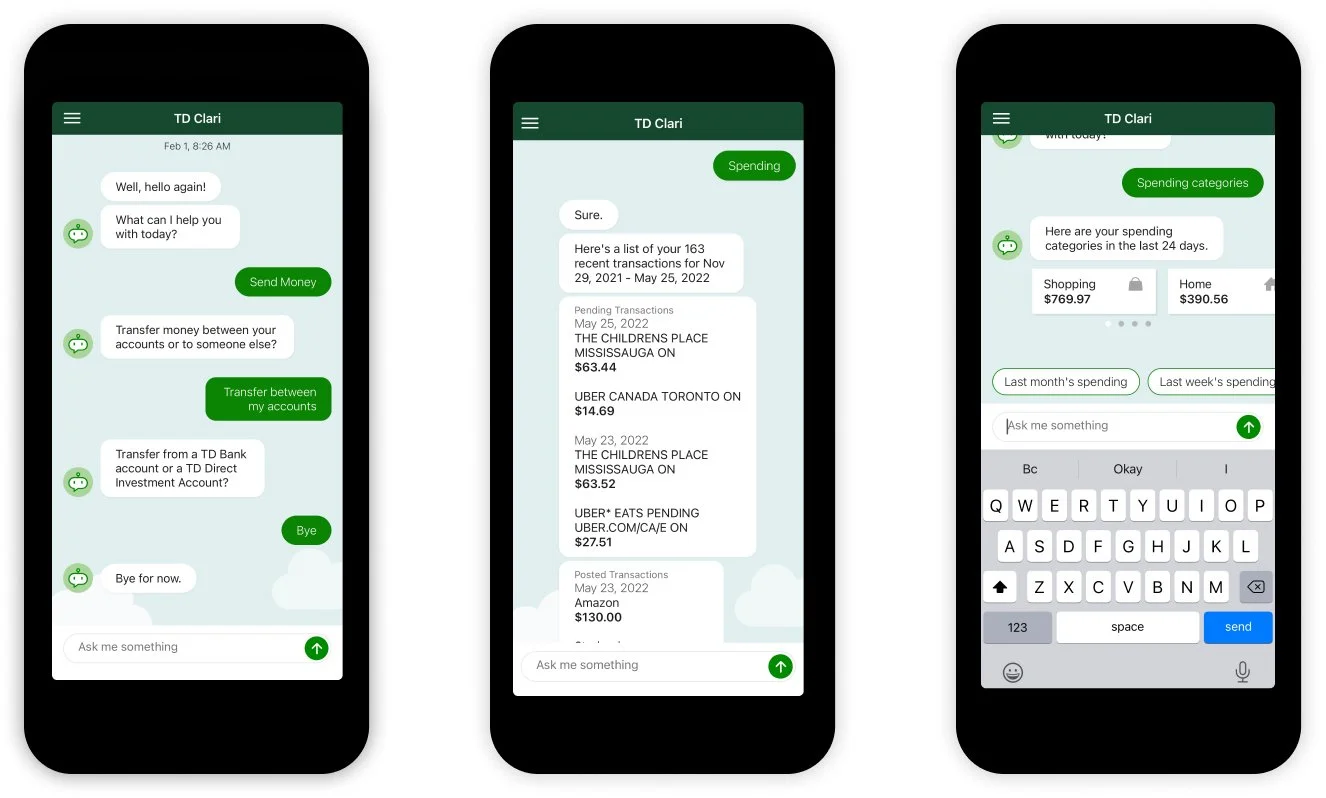
One of the most interesting research discoveries was that customers wanted to know about their spending patterns, learn about upcoming bill payments and even wanted a single, unified view of their consolidated account balances along with generic intents like how do I access my bank statements, what is two-step verification, etc.
The Insight
Customers didn't think in channels, they thought in goals. They wanted to solve a problem, not decide whether to search FAQs, call support, or visit a branch. This insight changed the question from "How do we improve our support channels?" to "How do we create one experience that starts with the customer's intent?"

My Responsibilities
Defined conversational strategy and tone of voice
Established content standards
Influenced content direction while working with LoBs and Legal/Compliance teams.
Partnered with AI/ML vendor
Led content reviews
Governed conversational quality
Designing the Experience
Rather than treating Clari as an FAQ bot, we designed conversations around customer goals. Each supported intent enabled customers to complete tasks directly within the experience whenever possible, reducing friction and encouraging repeat use.
Challenge: Cross-Functional Collaboration
Building Clari after a few weeks required close collaboration between largely two sets of collaborators - AI/ML vendor partners and the LoB reps.
The AI/ML vendors had a complicated backend system where a linguist would add intents to the system basis their rules but this was a time consuming process with limitations that didn’t allow us to be as agile as we wanted to be. Similarly, it was tricky to manage LoB timelines as they had their own competing priorities.
Solution: The Tranche Effect
We released intents in batches. For example, 30 intents across 12 LoBs. 45 days. This made sure that we had a clear release path to follow, everyone was working towards the same goal, and friction was reduced.
The Tone-First Content Strategy
I developed the conversational content strategy, defining Clari's personality, tone of voice, and writing standards. The goal was to create an assistant that felt consistent with the bank's brand while remaining clear, trustworthy, and task-focused.
We wanted the bot to feel approachable. So, we built something that sounded confident, while setting clear expectations about what the bot was designed to achieve.
Challenge: The Loop
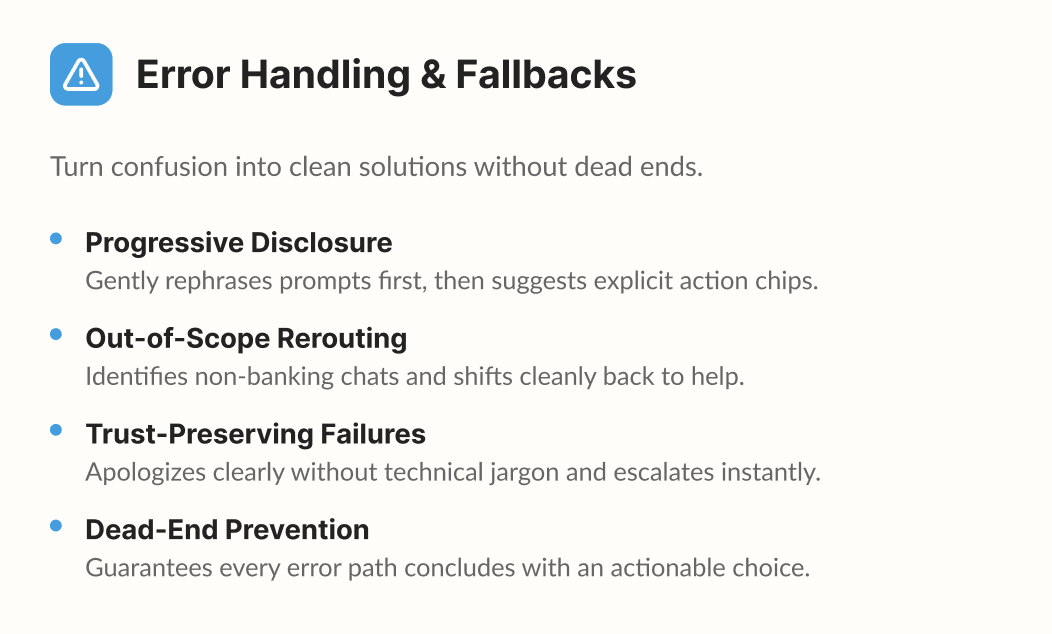
Customers needed a fallback option in case the bot glitched or their intent wasn’t understood. Even in scenarios where everything was as intended, we needed a path to completing more intents. So, we designed quick replies to give them that path and help users recover when the bot couldn't confidently identify an intent with common next steps.
Challenge: Content Governance
As more LoBs adopted Clari, maintaining content quality became as important as creating new conversations. I established content standards and reviewed processes that empowered teams to publish content which would create consistent customer experiences.
Our handoffs included a MS Word document with the content authoring template and a Confluence page outlining all the rules and constraints of the platform. Additionally, most writers were advised to reach out to me till about a year after I moved on to other initiatives (this wasn’t part of the governance process but due to the depth of experiences and knowledge I had).
Challenge: Technical Constraints
I had to consistently act as a gatekeeper to business demands that weren’t in line with the requirements in place. LoBs would try and add content without wanting to adhere to the content standards we had set keeping the platform requirements in mind.
For example, we had an Omnidial feature where about 5-6 lines of business had invested in pre-programming Omnidial numbers for these business units. Other units attempted to ‘forcefit’ their numbers in during content development and review. This was a massive issue as a customer would not be able to dial the number or copy-paste it inside the ‘Clariverse’ (due to system limitations). We succeeded in blocking such requests each and every time - we had our own business partners onboard and we never ever let any stakeholder alter the quality of what we had created.
Key Decisions
The key design shift was moving from a channel-first experience to a goal-first experience.
Established governance standards before scaling content creation across business units.
Prioritized trust and consistency over a highly anthropomorphic chatbot personality.
Challenged stakeholder requests when they conflicted with technical constraints or customer experience.
Results
Within the first 90 days, 6% of all new mobile app customers engaged with Clari at least three times, demonstrating meaningful repeat usage for a newly launched conversational experience. More importantly, the project established the content standards and governance model that supported future growth of the platform.
Reflection
At the time, our goal was to consolidate support into a single conversational experience, and for the technology available then, an intent-based assistant was the right solution. If I were approaching the problem today, I'd start from a different premise. Rather than designing a destination chatbot, I'd explore how AI could become an intelligent layer across the app such as understanding context, anticipating customer needs, and providing help within the journey itself. The goal of helping customers accomplish what they came to do hasn’t changed, but the way I'd design that experience certainly has.